Gyroid vs. Cubic vs. Grid Infill & Wall Loops: 2026 Strength & Speed Study
Should you crank infill up to 50% or add extra outer walls? And why do modern high-speed printers warn against classic Grid infill? We benchmarked Gyroid, Cubic, Adaptive Cubic, Grid, and Rectilinear patterns plus 2 to 6 wall loops and 0.4mm vs. 0.6mm nozzles on real functional parts.
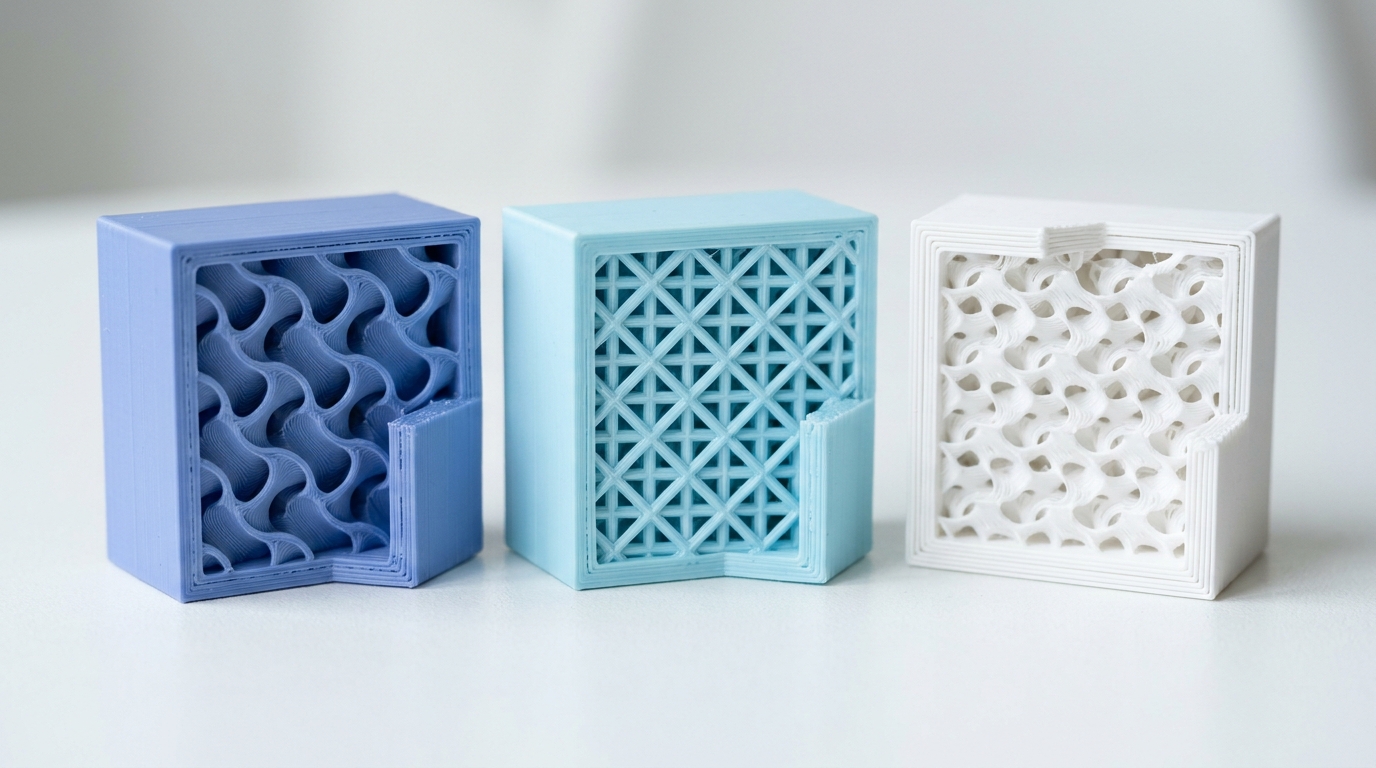
Parts Tested in This 2026 Slicer & Load Benchmark
60mm Gusseted Shelf L-Bracket
Side-printed PETG bracket used to test 2, 3, 4, and 6 perimeter wall loops vs. 15%–40% infill under static load.
4×4 Gridfinity Drawer Baseplate
Tested across 0.4mm and 0.6mm nozzles to benchmark large-footprint perimeter travel and wall speed.
IKEA Skadis 120mm Pegboard Shelf
Evaluated with Gyroid vs. Grid infill to confirm zero nozzle-crossing vibration on cantilevered wall hooks.
Dataset 1: Gyroid vs. Cubic vs. Adaptive Cubic vs. Grid vs. Rectilinear (20% Infill)
Benchmarked on a 256×256mm CoreXY printer (0.4mm nozzle, 0.20mm layer height, 3 walls, 200 mm/s infill speed) using a standard 60 × 60 × 28 mm PETG test block.
| Infill Pattern | Directional Strength | Same-Layer Nozzle Crossings? | Print Time (Test Block) | High-Speed Printer Risk | Best 3D PrintHaus Use Case |
|---|---|---|---|---|---|
| Gyroid | Isotropic (Balanced X/Y/Z) | No (continuous waves) | 48 min |
None (quiet & smooth) | 90% of functional brackets, hooks & boxes |
| Cubic | High 3D compression | Yes (3D cubes) | 46 min |
Low (angled passes) | Heavy vertical weight & tool-chest risers |
| Adaptive Cubic | High near skin, light core | Yes (scaled cubes) | 42 min |
Low | Deep Gridfinity bins & bulky game trays |
| Grid | 2D strong, weak diagonally | Yes (every layer) | 41 min |
High (nozzle clicks at 200+ mm/s) | Legacy slow printers only (avoid on CoreXY) |
| Rectilinear | Low (single-axis lines) | No (alternates per layer) | 38 min | None | Fast fit-test drafts & non-load desk cups |
Dataset 2: Wall Loops (Perimeters) vs. Infill Percentage on a 60mm PETG L-Bracket
Measured with static vertical hang weights on side-printed 60×60mm PETG L-brackets (0.4mm nozzle, 0.20mm layers, $21.00/kg PETG). Outer shells carry nearly all bending stress, making wall count the highest-return strength setting.
| Wall Loops × Infill | Solid Shell Thickness | Bracket Weight | Print Time | Observed Static Hold | Strength-to-Gram Efficiency |
|---|---|---|---|---|---|
| 2 Walls + 15% Gyroid | 0.84 mm |
19.4 g |
36 min |
4.8 kg (10.6 lbs) |
0.25 kg / g (Light duty) |
| 2 Walls + 40% Grid | 0.84 mm |
30.6 g |
62 min |
6.5 kg (14.3 lbs) |
0.21 kg / g (Wastes plastic) |
| 4 Walls + 15% Gyroid | 1.68 mm |
25.0 g |
48 min |
8.5 kg (18.7 lbs) | 0.34 kg / g (Sweet spot) |
| 6 Walls + 25% Gyroid | 2.52 mm |
31.2 g |
58 min |
10.4 kg (22.9 lbs) | 0.33 kg / g (Heavy-duty mounts) |
Dataset 3: 0.4mm Standard vs. 0.6mm High-Flow Nozzle Speed & Tolerance
| Metric / Part Feature | 0.4 mm Standard Nozzle | 0.6 mm Fast Nozzle | Real-World Difference |
|---|---|---|---|
| Typical Layer Height & Line Width | 0.20 mm height × 0.42 mm width |
0.28 – 0.30 mm height × 0.62 mm width |
2 walls @ 0.6mm = 1.24mm (nearly matches 3 walls @ 0.4mm) |
| 4×4 Gridfinity Baseplate Print Time | 44 min (22 g PLA) |
26 min (23 g PLA) | 41% faster print with identical bin fit |
| 2×3 Four-Section Drawer Bin Time | 1h 24m (48 g PLA) |
49 min (51 g PLA) | 42% faster print; stronger thick divider walls |
| Recommended XY Hole / Snap Compensation | +0.00 mm (tool defaults) |
+0.10 to +0.15 mm hole expansion |
Prevents tight 6×2mm magnet pockets on wider extrusions |
| Minimum Crisp Detail (Cutters & Text) | 0.80 mm blade / 1.2 mm text |
1.25 mm blade / 1.8 mm text |
Keep 0.4mm nozzle for fine cookie cutters & small stakes |
Cite This Study
Frequently Asked Questions
Is Gyroid or Grid infill stronger for functional 3D prints?
Gyroid is stronger and much safer on fast 200mm/s printers. Unlike Grid infill, Gyroid lines never cross over hardened plastic on the same layer, eliminating nozzle-scraping clicks and giving balanced strength in all directions.
Do extra wall loops or higher infill percentage add more part strength?
Extra wall loops add far more bending and bracket strength per gram of plastic than high infill. In our static load test, 4 walls with 15% Gyroid outperformed 2 walls with 40% Grid while using 18% less plastic and printing faster.
When should I switch from a 0.4mm nozzle to a 0.6mm nozzle?
Switch to a 0.6mm nozzle for large drawer bins, Gridfinity baseplates, shelf brackets, and thick boxes where high flow (up to 32 mm3/s) cuts print time by 35 to 45 percent. Keep a 0.4mm nozzle for fine raised text, cookie-cutter 0.8mm blades, and tight snap clips.
How many top and bottom solid layers should I use with 15% Gyroid infill?
Use 4 to 5 top solid layers and 4 bottom solid layers at a 0.20mm layer height (at least 0.8mm to 1.0mm thick). Fewer than 4 top layers can sag slightly or pillow over open 15% infill pockets.